








【A-PAD Indonesia】 Newsletter is Now Available
2025.05.20
A-PAD Indonesia published its first newsletter in May 2025. This issue covers the first quarter (February to April 2025) of the Grant Assistance for Japanese NGO Projects supported by the Ministry of Foreign Affairs of Japan.
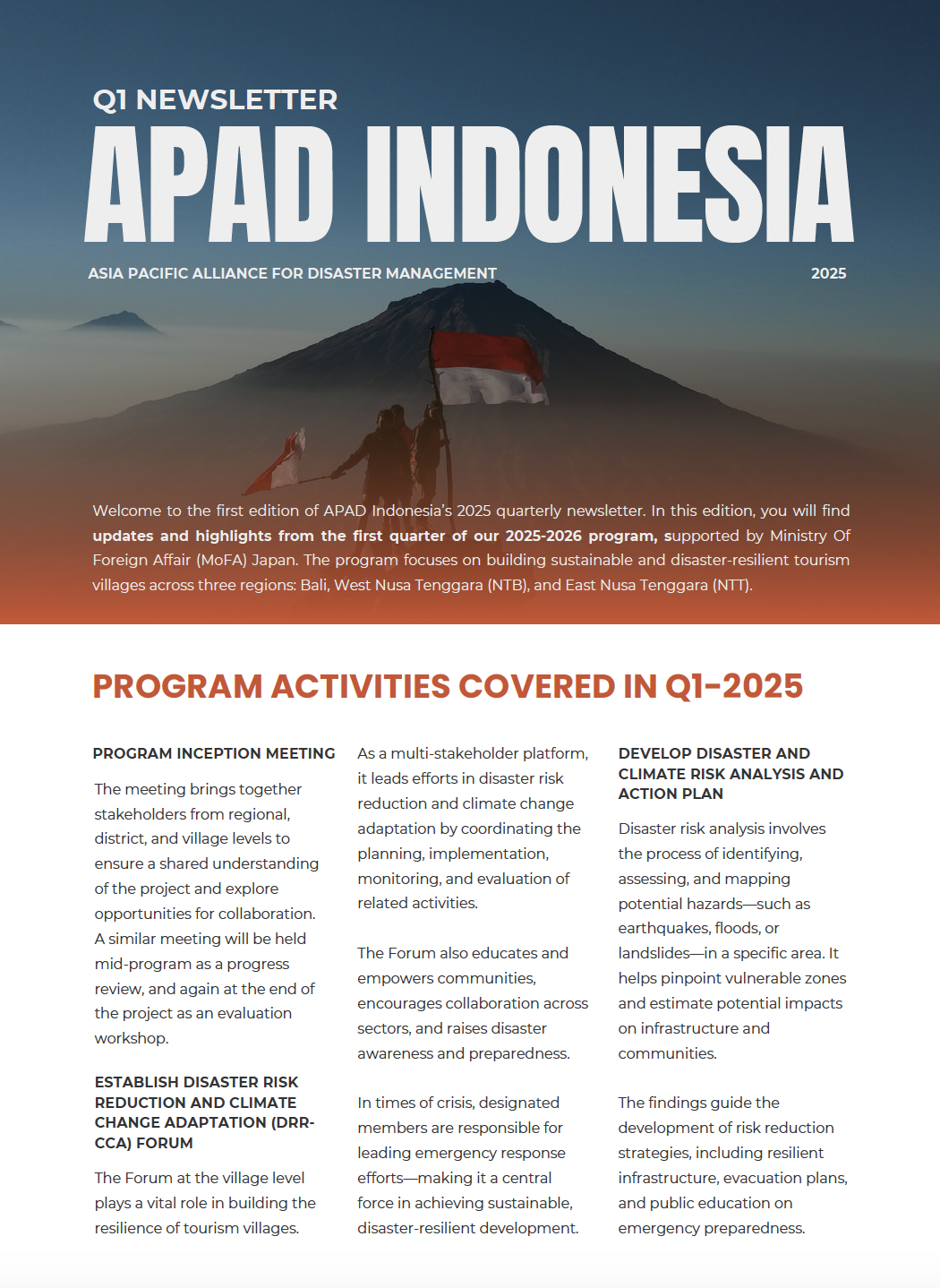
A-PAD Indonesia Q1 Newsletter 2025.05
The project titled “Building Disaster Resilience of Tourism Village Communities through Promoting Multi-Sector Collaboration” was launched in February 2025. It focuses on creating sustainable, disaster-resilient tourism destinations in the three provinces of Bali, West Nusa Tenggara, and East Nusa Tenggara. In March, local governments and related stakeholders from each of the three states gathered at a kickoff meeting to share the project’s objectives and future activities.
In April, the Disaster Risk Reduction and Climate Change Adaptation (DRR-CCA) Forum was established in the three states. Disaster prevention and mitigation action plans were developed that take into account climate change risks.
The forum aims to build resilience in tourism village communities and will act as a multi-stakeholder platform to plan, implement, monitor and evaluate activities to reduce disaster risk and adapt to climate change. At the same time, the forum will contribute to educating and empowering local communities, promoting inter-sectoral collaboration and raising disaster preparedness awareness.
As part of our preparedness and mitigation action plan, we also conducted a disaster risk analysis. By anticipating, assessing and mapping potential hazards in each region, we were able to identify vulnerable areas and estimate their impact on infrastructure and communities. Based on the results of this analysis we developed risk reduction strategies, including disaster-resilient infrastructure, evacuation plans and public education on emergency preparedness.